Encrypted Chat vs Regular Messaging: Which Is Actually Private?
Is encrypted chat private? Compare SMS, email, WhatsApp, and browser chat security to discover who can read your messages in 2026.
Use this guide with
Encrypted Chat
Create a private encrypted chat room and invite others with a room ID.
- •Overview
- •What does end-to-end encryption actually mean?
- •Is WhatsApp/SMS/Email really private?
- •Is SMS text messaging encrypted?
- •Can WhatsApp read your messages?
- •What about regular email?
- •Messaging Security & Encryption Comparison
- •What can go wrong even with encrypted apps?
- •When should you use a truly private/no-log encrypted chat?
- •Try a no-signup encrypted chat room
- •Frequently Asked Questions
- •Conclusion
Overview
Every single day, billions of digital messages—from casual text updates and business emails to financial notes and confidential health conversations—fly across global data networks. But when you send a message online, who can actually read it?
Many popular messaging platforms promise privacy, yet few users realize the profound architectural differences between regular SMS text messaging, standard email, consumer chat apps like WhatsApp, and client-side browser encrypted chat systems.
Whether you are curious about daily digital privacy or need to share sensitive credentials without leaving a permanent audit trail, understanding how message encryption works is essential knowledge in 2026.
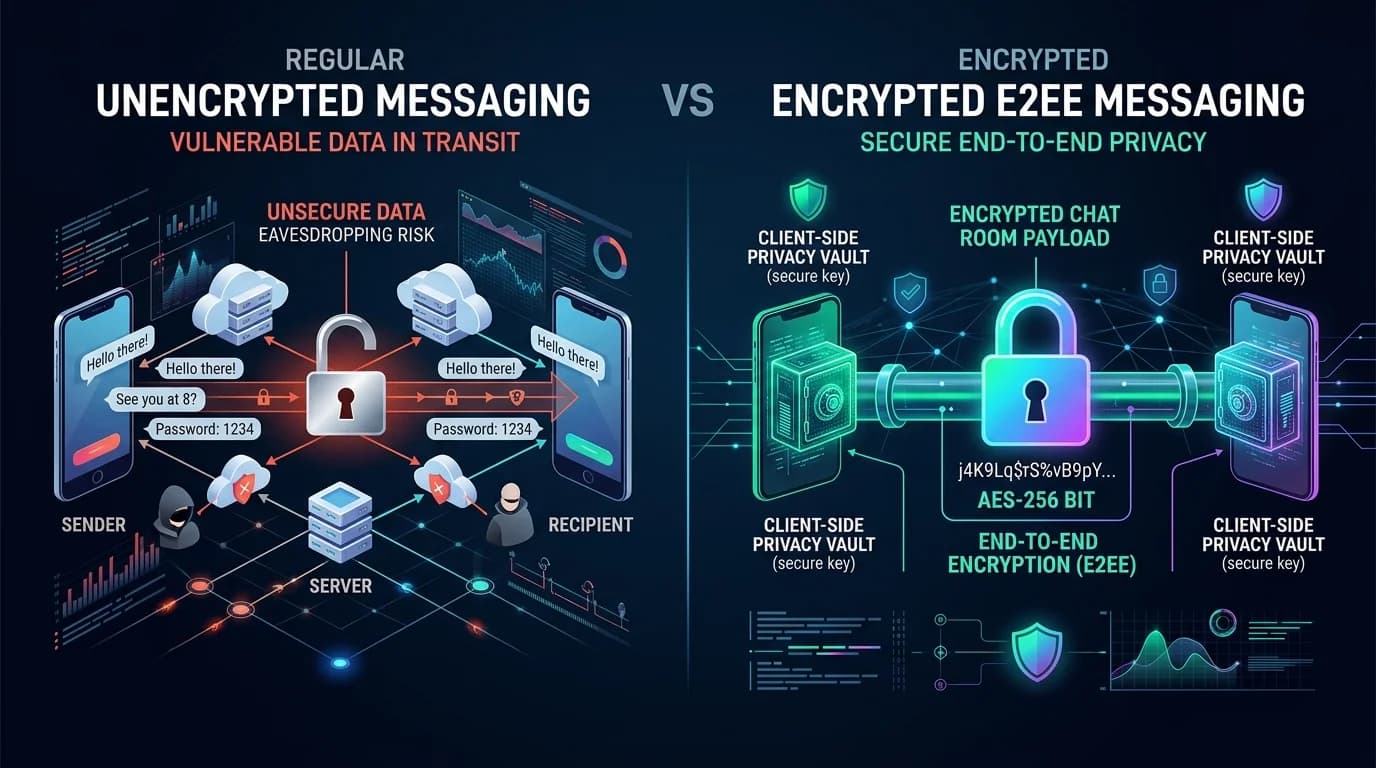
Direct Answer: Encrypted chat is private only when end-to-end encryption (E2EE) or zero-knowledge client-side encryption is active, ensuring that only the sender and recipient hold the decryption keys. Standard messaging like SMS and plain email transmits unencrypted text readable by cellular carriers and email providers. While apps like WhatsApp encrypt message content, metadata leaks and cloud backups can still compromise overall privacy.
What does end-to-end encryption actually mean?
To understand digital privacy, we must strip away complex cryptographic jargon. End-to-End Encryption (E2EE) means that your plain text message is scrambled into mathematical gibberish (ciphertext) directly on your device before it travels over the internet, and can only be unscrambled by the recipient's device.
Imagine writing a confidential letter. Standard unencrypted messaging is like writing your note on the back of an open postcard: anyone handling the card along the postal route—the mail carrier, sorting facility workers, or anyone looking over your shoulder—can read every word effortlessly.
Transport Layer Security (TLS/HTTPS), which most websites use, is like locking your postcard inside an armored courier truck until it reaches the postal headquarters. The truck keeps thieves on the highway from seeing it, but once the parcel arrives at headquarters (the company's central server), server employees open the box and read your letter in plain text.
End-to-end encryption, by contrast, is like locking your note inside an indestructible, customized steel safe. You hand the locked box to the courier. The courier, transit hubs, and central server carry the safe, but none of them possess the key. Only your intended recipient holds the exact key needed to open the safe and read your message.
Modern encryption relies on established mathematical standards such as AES-256 and asymmetric public-key cryptography. To learn more about how secure communication standards are evaluated by privacy advocacy groups, review the EFF Surveillance Self-Defense Guide on Secure Messaging [VERIFY LINK].
Is WhatsApp/SMS/Email really private?
Not all messaging channels are created equal. Let's compare how standard messaging methods handle your confidential data behind the scenes.
Is SMS text messaging encrypted?
No. Traditional SMS text messaging is completely unencrypted. When you send an SMS message, your text travels across cellular tower networks in plain text. Mobile network carriers (such as Verizon, AT&T, or Vodafone) store your full message history, timestamps, and location data on central server logs for months or years.
Because SMS lacks encryption, it is highly vulnerable to IMSI-catchers (stingrays), law enforcement subpoenas, SIM-swapping identity theft, and Wi-Fi/cellular eavesdropping. Relying on SMS for sensitive information is one of the highest privacy risks in modern digital communication.
Can WhatsApp read your messages?
WhatsApp uses the industry-standard Signal protocol to provide end-to-end encryption for message content, meaning Meta (WhatsApp's parent company) cannot read the actual text of your messages in transit.
However, WhatsApp is not completely private. Meta collects extensive metadata—including who you chat with, when you chat, how frequently you communicate, your IP address, device telemetry, and contact lists. Furthermore, if you enable automatic cloud backups to Google Drive or iCloud without explicit encrypted password protection, your message history is stored in an unencrypted state where cloud providers and law enforcement can access it.
What about regular email?
Standard email services like Gmail, Outlook, or Yahoo use TLS encryption while messages travel across the web. However, once your email arrives at the provider's server, it is decrypted and stored in readable form. Email providers scan email text to serve targeted ads, train AI models, or filter spam. Email subject lines, sender details, and full message bodies remain accessible to server admins and third-party automated scripts.
Messaging Security & Encryption Comparison
The following table compares the privacy architectures of popular messaging methods against browser-native encrypted chat:
| Messaging Method | Encryption Type | Who Can Read Your Messages | Metadata & Log Retention | Privacy Risk Level |
|---|---|---|---|---|
| SMS Text Messaging | Zero Encryption (Plaintext) | Cellular Carriers, Law Enforcement, Interceptors | Full Message Text, Phone Numbers, Cell Tower Location | Critical Risk |
| Standard Email (Gmail/Outlook) | TLS Transport (Transit Only) | Email Service Providers, Ad Networks, Server Admins | Sender/Receiver Email, Subject Lines, IP Addresses | High Risk |
| WhatsApp / Mobile E2EE | Signal Protocol (End-to-End) | Only Recipient (Text); Meta collects metadata | Contact Graphs, IP Addresses, Device IDs, Timestamps | Moderate Risk |
| ToolsWebPro Encrypted Chat | AES-GCM 256-Bit (Client-Side) | Only Room Participants (Zero Server Access) | Zero Account/Contact Data, Zero Message Logs | Maximum Privacy |
Experience zero-log browser messaging by opening our free Encrypted Chat Tool.
Open the tool:
What can go wrong even with encrypted apps?
Even when an app uses strong end-to-end encryption, absolute privacy is never guaranteed. Understanding potential security vulnerabilities helps you maintain realistic expectations about your digital safety:
- 1. Metadata Leakage: Encryption protects what you said, but metadata reveals who you spoke to, how long you talked, and where you were located. For many intelligence operations, metadata is more valuable than message text.
- 2. Unencrypted Cloud Backups: Automatic device backups often store chat logs in plaintext on cloud servers, bypassing app-level encryption entirely.
- 3. Endpoint Compromise: If your smartphone or laptop has malware, keyloggers, or a malicious screen recorder, attackers can read your messages directly off your screen before encryption takes place.
- 4. Phone Number Identity Tracking: Apps like WhatsApp and Signal require linking personal mobile numbers. Public databases can cross-reference your phone number with your legal identity and social media profiles.
- 5. Human Factors & Screenshots: Encryption cannot stop your recipient from taking a screenshot, forwarding your text, or physically showing their device to someone else.
When should you use a truly private/no-log encrypted chat?
While traditional messaging apps are suitable for casual daily conversations, specific high-privacy scenarios demand ephemeral, no-registration communication:
- Sharing Sensitive Passwords & API Keys: Transmitting login credentials, Wi-Fi keys, or private crypto keys to a colleague without leaving permanent records in email sent folders or chat histories.
- Temporary Online Transactions: Coordinating with buyers or sellers on online marketplaces without exposing your personal phone number or real identity.
- Sensitive Personal & Business Discussions: Discussing confidential business negotiations, legal topics, or whistleblowing updates where zero data retention is mandatory.
- Cross-Platform Quick Messaging: Connecting instantly across desktop, iOS, and Android devices without installing mobile apps or creating user profiles.
When privacy is paramount, using our client-side Encrypted Chat Tool ensures your conversation remains completely private.
Open the tool:
Try a no-signup encrypted chat room
Ready to communicate without leaving a digital trail? ToolsWebPro provides a free, browser-based Encrypted Chat Tool designed for instant, zero-footprint messaging.
Unlike mobile messaging platforms that require phone numbers and account creation, ToolsWebPro Secure Chat runs 100% inside your browser memory using client-side AES-GCM 256-bit Web Crypto API primitives.
- Zero Account Registration: No phone numbers, email addresses, or usernames required.
- Client-Side Encryption: Messages are encrypted in browser RAM before transmission; our servers only see unreadable ciphertext.
- Ephemeral Memory: Closing the browser tab instantly purges room keys and chat history forever.
Open the tool:
Frequently Asked Questions
Is encrypted chat private from my Internet Service Provider (ISP)?
Yes, when end-to-end or client-side encryption is used, your ISP can only see encrypted ciphertext and metadata (such as destination IP addresses). They cannot read the contents of your chat messages.
Is WhatsApp really private if Meta owns it?
WhatsApp uses Signal's end-to-end encryption for message content, so Meta cannot read the text of your chats. However, Meta collects extensive messaging metadata, including contact lists, timestamps, IP addresses, and device profiles.
Why is SMS text messaging considered unsafe for sensitive information?
SMS messages are transmitted over cellular networks in plain unencrypted text. Cellular carriers store SMS logs on remote servers, making them vulnerable to law enforcement subpoenas, IMSI-catcher interception, and SIM-swapping attacks.
What is the difference between transport encryption and end-to-end encryption?
Transport encryption (TLS/HTTPS) only protects messages while in transit between your device and the web server, allowing server admins to read message content. End-to-end encryption keeps messages encrypted from the sender's device directly to the recipient's device.
How does a browser-based encrypted chat room protect privacy without an app?
Browser-based tools like ToolsWebPro Secure Chat execute AES-GCM 256-bit encryption locally in browser RAM using Web Crypto API. Rooms are ephemeral, requiring zero phone numbers or account signups, and vanish completely when the tab closes.
Conclusion
The question 'Is encrypted chat private?' comes down to architecture. While regular SMS and email leave your messages exposed on central servers, true privacy requires end-to-end or client-side encryption without persistent contact tracking.
Protect your confidential communications today by opening a private session in our Encrypted Chat Tool.
Open the tool:
Muhammad Saqlain
Cybersecurity Practitioner & Lead EngineerSecurity researcher, web developer, and founder of ToolsWebPro. Tests password entropy, GPU cracking speeds, and client-side encryption systems.
Read full author bio & credentials →Related ToolsWebPro tools
Open the free tool(s) for this guide — no signup required.
Browse all ToolsWebPro tools →More from ToolsWebPro